Personal project · in validation
Deciding what to eat and how to shop, without having to think about it every day.
PensaciMeno is a food assistant on Telegram that I am building and using myself. You talk to it like a chat: by text, by voice, or with a photo of the fridge. It keeps track of meals, knows what is in the pantry, suggests what to cook, reminds you when to start and prepares the shopping list. Before opening it to others, I am validating it on myself.
- Projects
- PensaciMeno
- Status
- Personal product in validation
- Period
- 2026 – present
- Landing page
- pensacimeno.netlify.app
- Technologies
- TypeScript
- Node.js
- Telegram
- OpenAI
- SQLite
01The problem
Choosing what to eat every day, remembering what is at home and organising the shopping weighs on people who struggle with planning tasks. Nutrition apps ask for precise data entry; here the point is to lighten the decision, not to add another log to fill in.
02My contribution
A personal project that I defined and built on my own: product scope, data model, nutrition engine, integration with Telegram and the language model, landing page and the first trial and subscription cycle.
03How it works
- 01Person
Message
I write, speak or send a photo of the fridge, pantry or a label, as in any chat.
- 02AI
Interpretation
The language model understands what I mean: a meal eaten, a correction, a profile change, a request. For photos, it says what it thinks it sees.
- 03Person
Confirmation
Anything that changes my data, such as the pantry after a photo, is written only after I confirm.
- 04System
Calculation
The code, not the model, computes energy needs, protein and what is left to eat in the day, always as a range rather than an exact value.
- 05System
Suggestion and reminder
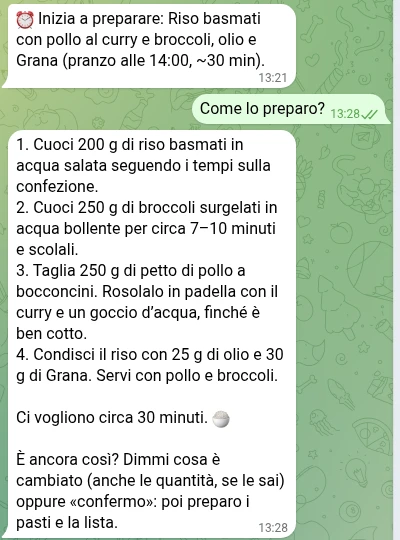
The system suggests a meal based on profile, pantry and recent meals, and sends the reminder at the right time to start preparing it.
04Integrations
Telegram assistant · TypeScript, Node.js
- TelegramThe single conversation channel: text, voice notes, photos and confirmation buttons; reminders go out from here too.two-way
- OpenAIInterprets messages, voice notes and photos; suggests meals. It does not compute nutritional values.two-way
- SQL databaseProfile, meals, pantry, shopping list and food library, separated per user.two-way
- StripeFree trial and subscription, in test mode while the product is in validation.two-way
05Where people step in
I decide. The assistant suggests and asks for confirmation before writing to the data; every estimated value can be corrected in natural language, and the correction recalculates only that entry.
06Technical decisions
- The language model converses, the code calculates: nutritional values are deterministic and covered by tests.
- Log immediately, even with an estimate: precision comes later, if needed, because consistency matters more than accuracy.
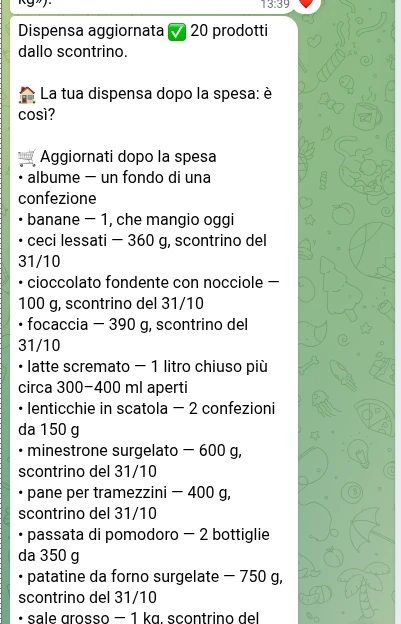
- A «fuzzy» pantry: items have states such as «in stock», «running low», «probably there», and change only with what I say, show or buy.
- Per-user data isolation from the start, with invitation-based access, so opening it to a small group of friends does not mean rewriting the model.
- Stated purpose: food organisation and personal wellbeing, not diagnosis or therapy.
07Status and evidence
Personal product in validation
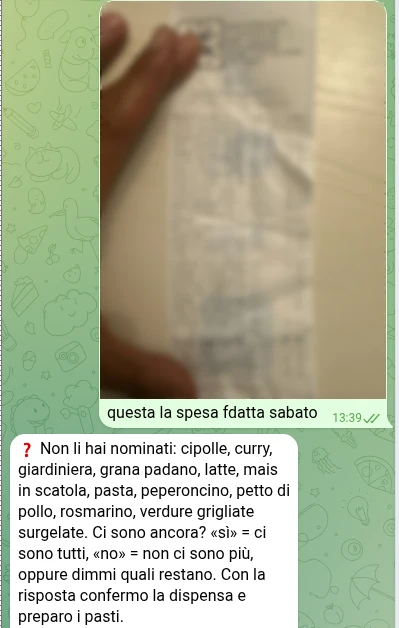
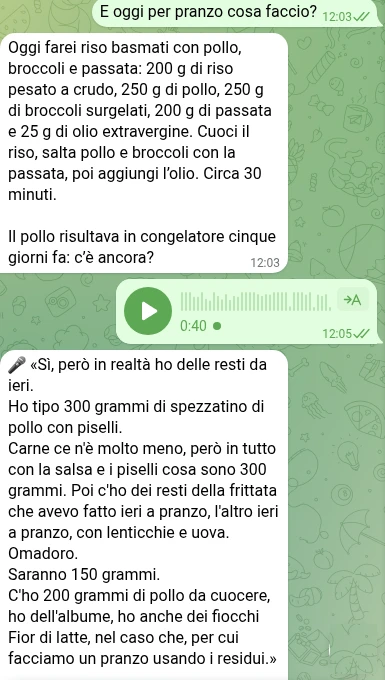
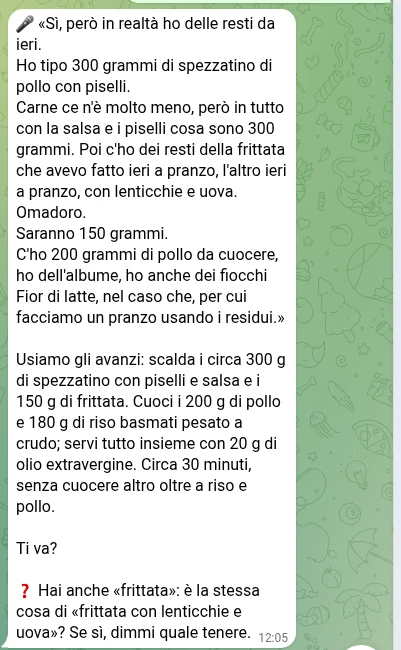
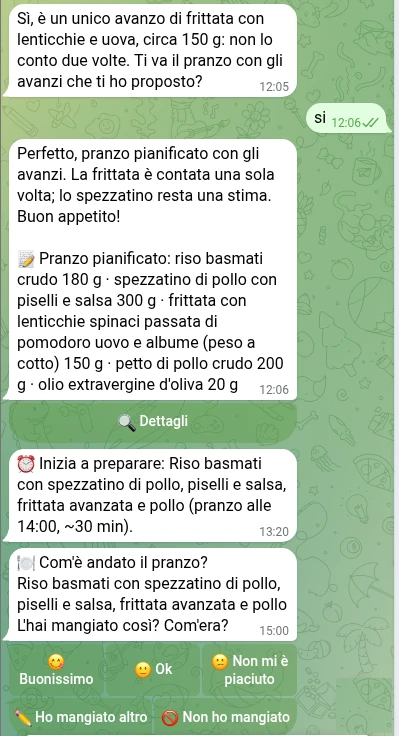
Product in validation: I am the first user, then it will open to a small group of friends. I report no usage data or results. The screens are real conversations with the bot, cropped to remove the header, with the photo of the receipt blurred; the code has an automated test suite, but that is not the same as demonstrated use. The landing page is live and describes the service.